≡ Menu
Image of the game Pac-man, to represent consolidation.

Flat-fee platform Interactive Investor looks set to gobble up rival platform EQi. It’s just the latest in a Hungry Hippos frenzy of deals in the UK.

What should we little guys make of all these clashes of the corporate titans?

This latest Borg-ing is still unconfirmed, but according to Sky News:

II is close to announcing the purchase of EQi, a division of the FTSE-250 support services group Equiniti.

City sources said this weekend that II had agree to pay in the region of £50m for EQi.

Sky News, 17 January 2021

Sky News has a history of on-target business scoops. EQi’s parent Equiniti has now confirmed to the market it’s in talks. The Sky article is written in language that suggests the reporter has been told it’s a done deal.

And the merger makes financial sense to me, too.

Low-fee execution-only online stockbroking is a scale game. The more customers and assets under administration a platform has, the more the costs of its website and trading infrastructure are spread around.

True, extra customers generate extra customer support. So it’s not entirely cost-less to scale.

Hargreaves Lansdown played catch-up for a couple of years to keep its vaunted higher levels of service up to snuff. That showed up in rising expenses in its reporting.

But even service could improve with a larger asset base. It could mean more money to invest in automated solutions, for instance, such as better chatbots.

Higher revenues should also mean more money to fix problems that would have caused the customer issues in the first place.

I’m sure it’s also potentially cheaper to acquire customers via acquisition than by marketing to them. Internet advertising is very crowded.

Against all that, there’s the hassle of integrating a new system – or at the least a new cohort of customers – with the predator’s existing setup.

Makeover, takeover

So much for the broker oligarchs justifying expanding their fiefdoms.

Everyday savers like us might wonder: what’s in it for us?

The loss of EQI would not remove a huge competitive force from the landscape.

The EQi platform was itself born by the takeover of Selftrade a few years ago. It had a rebrand and a website makeover that was a bit marmite-y to users. But it’s hardly shaken up the market.

As for EQi’s fee structure, my co-blogger and platform maven The Accumulator describes it as “absolutely byzantine”.

The Accumulator should know – he’s the man who crunches this stuff for our broker comparison table.

In his latest once-over, TA found EQi did have appeal for investors building a portfolio from ETFs who wanted an unrestricted range of options. (Compared to Vanguard, say, which only offers its own funds).

Seems a niche market, though.

Consolations of consolidation

Beyond the specifics of this deal, I can see some advantages for consumers of ever-bigger platforms:

  • Cost savings might be passed on to consumers as lower charges
  • Potentially more stability and superior customer service
  • ‘To big to fail’ platforms should invite greater regulatory scrutiny, reducing the risk of systemic failure
  • Arguably fewer, larger platforms could be more competitive with each other than with myriad smaller, weaker rivals

On the other hand, there’s reason to fear relentless consolidation.

For a start it’s a hassle. I’ve had trading records vanish following a merger. You might also have to redo elements of identifying yourself to the platform. The acquirers’ anti-money laundering standards may be higher or different.

More importantly for the long-term, there must be a danger that it could reduce competition.

Dealing fees should fall further

Right now the UK investing scene seems fairly competitive – but with definite room for improvement.

In the US trading fees on stocks have pretty much vanished on the major platforms. That shows we’ve still got work to do here.

We do have Freetrade in the UK, and very popular it is, too. But a quick look at our table shows plenty of trading fees being levied by other brokers.

I believe charging dealing fees is no longer sustainable. Any execution-only trade costs basically nothing for a platform to execute these days. With the likes of Freetrade highlighting and exploiting that, rivals look dear. I can only see dealing fees eventually going to zero in the UK.

This suggests we have little to fear from rising prices for share dealing.

As for funds, it’s hard for platforms to hike prices too much with Vanguard now operating in the UK. At least for sensible index investors.

Vanguard may not be the cheapest option for all passive investors in all circumstances. But it is close and it acts as a huge gravity well pulling down what other platforms can realistically charge.

Then there are all the fintechs and neobanks pushing towards adding share dealing and other investing services to their offerings.

Again, hard to see the opportunity to hike prices if other firms are making dealing a bolt-on commodity.

Show me the money

Before anyone begins to feel sorry for the plight of platforms, note the big ones make plenty of money.

Hargreaves Lansdown had £104bn in assets under administration as of June 2020. It claims to have just over 41% of the direct-to-consumer platform market, so it’s by far the biggest beast.

On that hefty market share Hargreaves generated £551m in revenues to June 2020. This turned in a pretax profit of £378m, thanks to the chunky margins the platform enjoys.

Its shareholders can decide whether this was good enough to justify Hargreaves Lansdown’s market cap of £7.45bn.

The point is Hargreaves has a lot of profit levers to pull to make money. As well as lots of margin fat to eat into.

It’s a similar story at fellow listed broker AJ Bell. It has £56.5bn of assets under administration, on which it turned a profit of £49m.

Interactive Investor reportedly has £36bn of customer money under its purview to-date. Talk is the company will float some time this year. At that point we would get more insight into its financials.

Meanwhile Freetrade has gathered hundreds of thousands of customers. But when it last raised money it was still not reporting a profit. The start-up has been choosing instead to reinvest any cash generated into the business for growth. It has raised successive rounds of capital to keep the lights on.

The jury is still out on the Freetrade business mode. Clearly it’s a pressure for competitors to reckon with though.

Plenty of platforms in the sea

We’re still far from having to worry about competition being diminished when it comes to investing platforms in Britain.

As our broker comparison table demonstrates, there’s still plenty of options, even after an Interactive Investor / EQi marriage. Our table doesn’t yet include all robo-advisers and the like, either.

Sure, the endless corporate coupling is something to keep an eye on.

But for now I’m content these mergers reflect brokerages fighting to ensure they’ll be left standing among the winners. As opposed to nailing on that we investors will be the losers.

Still, I’m a naughty active investor who is used to paying higher costs than most (sensible) Monevator readers.

I’d be interested in hearing what you guys think in the comments below?

Note: This article contains affiliate links to Interactive Investor, Hargreaves Lansdown, AJ Bell, and Freetrade. If you sign up we might receive a payment from the company, but that doesn’t affect the price you pay. At the time of writing the author is an investor in Hargreaves Lansdown and Freetrade.


{ 21 comments }

Weekend reading: On balance, working from home wins

Weekend reading logo

What caught my eye this week.

We’re nearly a year into Covid in the UK. The novelty has long worn off – you hear much less about finding inner peace or baking sourdough – but on the working from home front, the revolution revelation continues.

Even the most lunch-is-for-wimps office junkies seem to be finally coming around to the reality that you can get plenty done from home.

In fact I’m getting tired of entrepreneurial types on my LinkedIn and Twitter feeds declaring they’ve seen the future and it’s here.

These guys remind me of dads who trumpet a hot up-and-coming band to their kids because they saw them last night headlining The Other Stage at Glastonbury on BBC 2.

Better 20 years late than never, I suppose.

Working from home works

The potential to work from home was never a secret. I’ve been at it most of my adult life, and I’ve shared the benefits before in articles like:

The start-up I co-founded 15 years ago mostly ran without an office, too.

Revolution? Retread more like.

I guess it takes a global pandemic for some people to try sending an email from a spare bedroom.

How did they manage before?

Perhaps I’m just bitter that the queues are going to be longer in Waitrose forever if so many of these weekday incomers stick about.

I’m probably also chippy thinking back to how hard it was to chisel days of working from home out of even supposedly flexible employers.

Most bosses believed staff were far more productive in offices. Really they meant they liked to keep an eye on them.

Generally, managers are pretty terrible. They’re not good at empowering their underlings or managing projects or workflows. Too many come across like that enthusiastic kid in school who would try to run from his goal line to tackle the ball halfway up the pitch and then maybe get a shot on goal.

These – ahem – midfield maestros saw the office as their playing field.

The last thing they wanted was for the metaphorical ball to be picked up and taken home.

Work from home to work less

Traditional employers’ productivity calculations never paid much attention to the hours it took for the employee to get to work, either.

Nor all the time it took to recover at home afterwards.

Let alone the maths of shuffling kids or pets or cars or anything else along the way.

These huge time sucks drop away when you’re working from home.

Indeed I recently read one blogger – and I presume recent convertee – claiming it could make a 50-hour work, split over a couple, the new normal:

Work from home has the potential to restore better family life for some without reducing net income.

With two parents working a total of 50 hours at home, they’ll be able both to care for their kids and be as productive as they were when nominally working 80 combined hours in the office and commuting to boot.

They won’t be materially worse off either. Both parents can have careers.

Even single parents will benefit from a shorter WFH week, although certainly not as much.

Well, maybe.

Whose hours are they, anyway?

I’m as big a zealot for flexible working from home as they come.

But expecting societywide benefits like this from a nation doing business in its sweatpants seems to me fanciful.

For one thing, if employers cotton on to all that extra capacity and time freed up, they’re going to try to reclaim it.

More perniciously, people have been claiming productivity gains will set us free for hundreds of years.

In reality people who could have worked fewer hours just tend to work longer to buy more stuff.

As I say, this lifestyle option isn’t new. For those who can do it today (brain surgeons not so much) it was always available if you made some sacrifices.

I don’t think working for just 25 hours a week will come naturally to yesterday’s commuting salaryman or woman.

Time to burn

I’ll tell you another secret about managing your own work and time from home.

It’s hard to stay so efficient forever.

When you first get off the commute-office-commute hamster wheel it’s nirvana. Not only are you fresh and productive, but you get tons of other stuff done in your screen breaks. Popping on the dishwasher, say, or a trip to the Post Office via Tesco Metro for a little shop.

However most of us can only get so much work done in a day. If you’re paid to work the same traditional hours anyway, I guarantee your efficiency will flag.

(If you’re a freelance or contractor paid for results, happy days. Get your stuff done by 2pm and take the rest of the day off. Or work a four-day week.)

Finally, I haven’t got kids but I hear they’re still popular in some parts and I can’t imagine how they fit into all this. Any parents want to weigh in below?

Have a great weekend, anyway. Try not to work too hard!

[continue reading…]

{ 73 comments }

Some ridiculous ETFs that we might as well market

Some ridiculous ETFs that we might as well market post image

From our coverage of sector and thematic ETFs, you may think we doubt the value of these exotic and expensive funds.

However following a phone call with our accountant, nothing could be further from the truth.

Indeed we’ve decided that if we can’t beat ’em, why don’t we compete with our own range of ultra-niche ETFs?

That’s one way to monetize our vast audience, right?

Five niche funds you never knew you needed

Today we present five ETFs we believe could be humongous – and we’re not just talking about the fees we’ll earn. (Though we mostly are).

Three of the fantasy so-bad-they-are-good exchange-traded funds are from my co-blogger, The Accumulator. They’re followed by two even more specialist vehicles conceived of by myself.

We’re pitching them to the ETF industry right now and expect to be rich by Christmas.

The AlphaDog Totalitarian ETF

Democracy just can’t compete in today’s fast-paced world. So this unequally weighted index backs regimes who know how to get things done. Our active management team will deliver skilfull execution (of opponents), exposure to alternative investments facts, and a flexible approach (to the truth). Past performance is not a guarantee of a future (for you). Indefinite lock-up periods likely. Expect to pay heavily. Capitalism at risk.

The iDespair Social Division ETF

Invest in the firms best-placed to profit from the most exciting social trends of our time. Think rancour, algorithmic hate, conspiracy theories, heavily armed law enforcement, tooled-up insurrectionists, and selfishness disguised as personal freedom. Available in Acc and Inc share classes because all Inc investors are scum and Acc investors are liberal snowflakes who hate their country.

The By Eck We’re All Doomed ETF

Everything is screwed so you might as well give us all your money. Using proprietary risk management woo-woo, we’ll sink your loot into booze, guns, and a sexbot colony on the dark side of the moon. Subscribers get a gold bar and a cyanide capsule by return of post. Friends and family discount available.

The Locked, Loaded, and Levered ETF of Levered ETFs ETF

Smart, switched-on Monevator readers demand – nay, deserve – something financially high-falutin’. Which is why I had this idea in the shower got my quant team to devise the leveraged ETF to end all leveraged ETFs (as well as your solvency). Despite us explaining how financial innovation and ETFs go together like a far right rally and the White House, people still buy them. Clearly there’s demand. So this fund makes it simple for you to get exposure (and us to get the shirt off your back). It invests in a basket of every 2x and 3x levered long and short ETF we can find. Don’t know what that means? You’re our ideal customer! (Excruciating charges apply. Please sign the attached waiver that permits us to raid your estate for exit fees. Anyone named Brewster may not invest their millions, because that’d be too easy).

The Out Of The Closet Shiny Wrapped Tracker Fund ETF

The wealthy have $3 trillion in hedge funds, despite them collectively doing worse than a cheap 60/40 portfolio. Everday investors are no better. They often buy closet index funds that charge more than a cheap tracker but hold the same assets. Clearly everyone wants to feel special. Well, why fight human nature? This ETF has just one holding – a super-cheap global index fund. However we promise to bury you in glossy quarterly updates, promotional videos extolling how our companies are fighting climate change, and to sponsor Manchester United. Naturally this all costs money, so we’ll charge you 1.75% a year for the privilege. But you’ll feel so good! (Investors who hoped from the name for a LGBTQ-friendly ETF should look into our queer-positive ETF – PINK£. It invests in a range of stereotypical and mildly offensive generic holdings but will give you a winning woke air when you hold forth about it at parties.)

Exotic funds are for flings, not marriage

You might think these five ETF suggestions are ridiculous.

But they’re only slightly more madcap than some of the funds we’ve seen hit the market. Especially in the US.

Everything from ETFs aiming to profit from the obesity epidemic to ways to play the tastes of millennials have been wafted before investors like roasted chestnuts in front of Dickensian street urchins.

Some of the less faddish ETFs may play a useful role, to be fair. Especially for macro investors who truly know what they are doing.

The iShares Automation & Robotics ETF (Ticker: RBOT) for instance attempts to address a big shift that’s underway in industry.

If you have a special insight into that sector’s prospects, it’s a cheaper and easier way to get exposure than by buying dozens of firms yourself.

But very few people do have such market-beating insights.

Remember, your chosen sector doesn’t just have to do well. The investments themselves need to outperform the market to make the allocation worth having.

At least stock pickers are less likely to get their hands blown off juggling diversified sector ETFs compared individual shares.

However for sensible passive investors who know what they know (and what they don’t know) such ETFs offer little beyond a fun side-flutter.

Far better to hold an ETF that gives you a bit of every sector and every fad under the sun. Like a global tracker fund!

Readers, have we missed a trick? Make your own exotic ETF suggestions in the comments below.

{ 28 comments }

How to invest in sectors, themes, and megatrends

Image of a section of a roulette wheel, to highlight the unpredictability of investing in sectors

Monevator reader Anna sent us a common question about investing in particular sectors of the stock market:

How should one behave if I would like to be overweight in a specific sector or theme, like clean energy or AI for instance, or perhaps being overweight in a specific country like Russia? Would it be possible to implement these themes in the global portfolio?

Our world is changing rapidly. The ground rules of our lives constantly shift beneath our feet as society is reshaped by geopolitical, socioeconomic, technological, and environmental transformation.

Surely we need to reposition our portfolios, then? Tweak them like wind turbines, pivoting to harness these powerful forces?

There’s an exchange-traded fund for that

The ETF industry certainly wants to help you feel like you’re in control.

For example a dozen climate change ETFs launched in Europe in 2020 alone, according to the ETF data service justETF.

Other ETFs enable you to invest in everything from cannabis to robotics, through esports, gender equality, genomics, and immunology.

Like fashion houses, fund providers know their job is to stay on trend.

Those options come on top of existing ETFs targeting sectors and industries, smart beta strategies, countries, and regions.

And that is but a cherry balanced on a giant fruitcake of investments of every candy-stripe – slicing and dicing the global economy into a pick ‘n’ mix cascade. 

All you have to do is predict which themes, megatrends, rising powers, and techno-tipping points will profitably rewrite the future.

(Ahem. “All”…)

Spread your bets

There was a similar explosion of ETFs in 2018 that enabled us to invest in exciting themes such as:

  • Blockchain
  • Cybersecurity
  • Artificial intelligence and robotics
  • Bio-tech
  • Battery tech

I picked a selection at random to see how they did.

It turned out that all these ETFs beat a plain old MSCI World ETF in the short-term 1:

Source: justETF [Click to enlarge.]

  • The MSCI World ETF benchmark (orange line) falls flat into last place with a 28% cumulative return over two years.
  • The battery ETF (grey line) went from last place to third in just six months, with a 83% cumulative return. Hmm, volatile!
  • The blockchain ETF beat the World ETF by less than 2% despite Bitcoin going berserk.
  • Try tearing your eyes away from the towering 121% return of the artificial intelligence ETF in the no.1 spot.

First AI beat me at chess, next it’s having my job, and now it’s a better investor, too? Humans are yesterday’s news, baby.

Maybe, but it’s easy to get overexcited about new toys.

Let’s take a longer term view

Here’s some megatrends that I could get medium range data for: 2

  • Big tech
  • Rise of China
  • Global water resources
  • Clean energy
  • Healthcare in the face of aging demographics
  • Global infrastructure fueled by urbanisation

Source: justETF [Click to enlarge.]

This time our MSCI World ‘accept you have no edge’ benchmark ETF (orange line) sits comfortably mid-table.

Three of the selected big trend ETFs beat the world market. Three under-performed.

Here are the scores (returns are cumulative):

  • Big tech – 931% – Win
  • Healthcare – 268% – Win
  • Global water – 267% – Win
  • World tracker – 213% – Acceptable
  • Global infrastructure – 114% – Fail
  • China – 101% – Fail
  • Clean energy – 14% – Fail

Are you surprised? Could you have predicted these outcomes in advance?

It’s not that the narrative behind the underperforming themes was wrong.

  • The world has continued to urbanise since 2007.
  • China has continued to rise.
  • Clean energy is a growing part of the world economy.

What then?

  • Was the importance of the theme overblown?
  • Were the companies overpriced?
  • Did the lion’s share of returns fail to accrue to shareholders – diverted instead to management, employees, customers, future investment, or private equity?
  • Was the industry hit by an ill-wind? Loss of subsidies, social backlash, constrained by regulation or the technology failing to fulfill its potential?
  • Was there something wrong with the index? Perhaps it wasn’t truly representative of the industry or country or was too concentrated in less competitive companies? Or did it include firms that jumped aboard a sexy new trend train but were mere passengers, not the real engines of growth?

Identifying a trend seems to be easier than profiting from it.

A much longer term view

To understand how the roulette wheel of progress affects market performance, I recommend reading Industries: Their Rise & Fall by the finance academics Dimson, Staunton, and Marsh.

Here’s their breakdown by industry sector of the US stock market in 1900 as compared to 2015:

Source: Credit Suisse Global Investment Returns Yearbook 2015

You can see that the market has been radically remixed over a century.

According to the professors:

Of the US firms listed in 1900, more than 80% of their value was in industries that are today small or extinct.

For instance it’s hard not to notice the huge blue wedge devoted to the rail industry in 1900. That snake-jawed Pacman was worth 63% of the market at the dawn of the Twentieth Century.

But by 2015 rail made up less than 1% of the stock market.

Meanwhile 62% of the 2015 US stock market’s value lay in industries that were negligible or nonexistent in 1900.

Back on this side of the pond, 65% of the 1900 UK market value resided in industries that were marginal or had disappeared by 2015, while 47% lay in industries that were small or not yet invented in 1900. (More evidence that US capitalism has been more dynamic than its UK counterpart?)

Here’s how those 1900-era industries fared against the market during the upheaval of the subsequent 115 years:

Source: Credit Suisse Global Investment Returns Yearbook 2015

The wider market is in dark red and is beaten by five industries.

Notice the market is beaten by rail (light green) despite its huge slice of the pie being reduced to crumbs by 2015.

But the runaway winner is tobacco.

What’s the story here?

Tobacco – addictive, cool, seductive as a ‘50s film star – so of course it won?

Given the number of kids in my school who couldn’t wait to drag on a fag, that was a plausible narrative up until the 1990s.

But few industries have taken such a cultural and regulatory battering in the developed world as tobacco since then.

The equivalent now would be placing all your chips on coal as the fuel of the future. Would you make that bet?

The Investor will pop a long in a moment to explain that pumping out cigarettes required little investment in innovation over the subsequent 100-plus years, and so it was wildly cash generative. Reinvesting that cash drove up returns. [Confession: I just popped along and did – @TI]

But multiplying the difficulty of picking a winning sector by the uncertain strength of its business models does not lead to odds I’m willing to take.

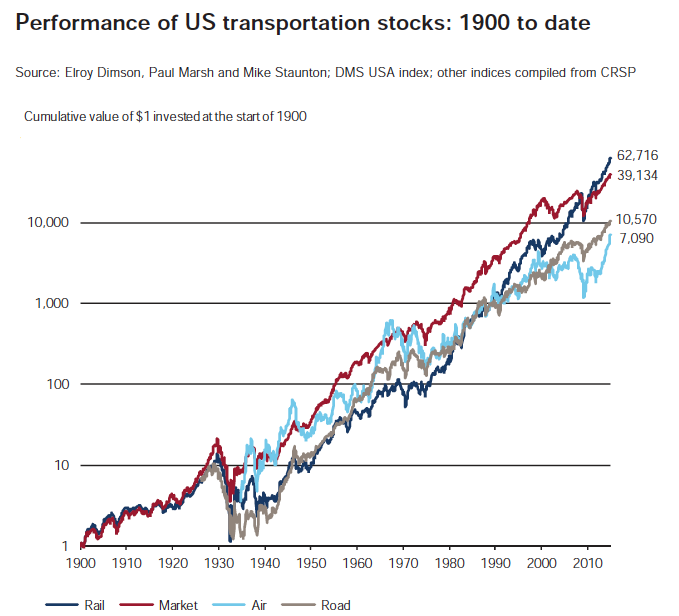
Here’s another counter-intuitive finding. The US rail industry was laid low by the rise of road and air, but rail is the only one of those industries that had beaten the market by 2015:

Source: Credit Suisse Global Investment Returns Yearbook 2015

Rail had a torrid time for 80 years, especially over the 1960s to 1980s. But it emerged fit as a super-productive flea to overtake the market in 2013.

The road industry never beat the market. Air had a few golden ages but always returned to earth with a bump.

Think of how unbelievably exciting the air industry must have looked after the role it played in World War 2. You can see the value of aviation equities spike in the mid-1940s in the graph above.

Would you have predicted that the air industry’s promise would not be fulfilled for shareholders, as opposed to the rest of society?

Could you credit that you’d have been better off just staying invested in the broad market?

The cycle of rise and fall

The merry-go-round of modern capitalism hastens our desire to predict new dawns and to declare existing hierarchies dead.

Survival in the knowledge economy makes us desperate to stay ahead of the curve, after all. 

Dimson, Staunton, and Marsh highlight market historian Jeremy Siegel’s explanation of this anxiety from an investing perspective:

Investors have a propensity to overpay for the ‘new’ while ignoring the ‘old’ …

Growth is so avidly sought after that it lures investors into overpriced stocks in fast-changing and competitive industries, where the few big winners cannot compensate for the myriad of losers.

The academics observe how technology cycles through:

  • Scepticism
  • Over-enthusiasm, which can lead to a bubble
  • Sober reassessment once everyone cools off

Could the explanation for the outperformance of AI, robotics, and battery tech in our first example be that investors are caught up in the over-enthusiasm phase?

Dimson, Staunton, and Marsh advise:

Investors should shun neither new nor old industries.

There can be times when stock prices in new industries reflect over-enthusiasm about growth, and times when investors become too pessimistic about declining industries.

However, it is dangerous to assume that investors persistently make errors in the same direction: they may at times underestimate the value of new technologies and overestimate the survival prospects of moribund industries.

It’s clear the market can be beaten. If you’d backed tobacco equities in 1900 then you’d have smashed the market over the long-term.

But can you beat the market?

Remember, as a passive investor you don’t have to get involved in making these explicit bets.

You already gain exposure to AI, robotics, cybersecurity, blockchain, China, and every other plausible investment narrative through a broadly diversified global tracker.

By over-weighting any theme, strategy, or country you’re claiming greater insight than the aggregate of all investing decisions that make up the market.

A market that’s dominated by huge financial players rather than greater fools. A market even the world’s best investors struggle to consistently beat.

Your prospects rest on this key insight from our academics:

It all depends on whether stock prices correctly embed expectations.

Expectations amount to the market’s best guess, given current information.

The smart money has better information than you or I. It reacts to new developments with frightening speed.

  • Did you see a global pandemic coming in 2020?
  • Did you see shares rebounding right after the fastest crash in history?
  • Can you predict the winners and losers as Covid-19 reorders society?

Or, to highlight another sweeping change, will big tech be more or less profitable by the time the antitrust lawsuits have played out?

As ex-hedge fund manager Lars Kroijer wrote about overweighting:

What is it that you know that the wider market doesn’t?

The best strategy is to be humble

Plan A is to stick with a global tracker fund.

Can’t resist a wee flutter?

Plan B is to limit the damage of being wrong.

Just like you wouldn’t bet your house on the outcome of the Grand National, keep your stock market bets survivable.

Overweight 10% of your equity allocation, tops.

Enough to enjoy your win should you back the right horse. But not so much that the pain will unbearable if you invest in the next air industry or Argentina.

Take it steady,

The Accumulator

  1. The time frame chosen was simply the maximum span over which I could compare these ETFs. It was no more scientific than that, and I don’t think it tells us anything except that the short-term is no guide to the quality of investing decisions.[]
  2. The time frame is the longest period I can compare the ETF selection against each other.[]
{ 35 comments }